
SQO — Sequencer Output
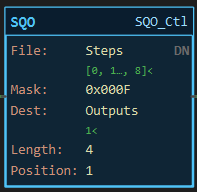
Description
Section titled “Description”SQO (Sequencer Output) steps through a table of output patterns. Each time its rung goes from false to true it advances the control tag’s position by one, reads the array element at that position, and writes it to Dest through a mask; bits where the mask is 0 are left as they were in Dest. Use SQO for a drum-sequence machine: a wash cycle, a traffic light, an indexing table whose outputs change step by step. Do not use SQO where a step must wait on a condition before advancing; the rung itself must carry that condition, and a step that should hold outputs while waiting is simply a step the rung does not advance past.
Operands
Section titled “Operands”| Operand | Type | Format | Valid Range | Required | Description |
|---|---|---|---|---|---|
| Control | CONTROL tag | Tag or Tag[n] |
One SQO per control tag | Yes | Holds LEN, POS and the status bits. |
| File | INT or DINT array tag | Tag |
At least Length + 1 elements | Yes | The table of patterns. Element 0 is the start position and is never output; steps are elements 1 to Length. |
| Mask | Whole number or tag | 0x000F, 255, Tag |
Any | Yes | Bits set to 1 in the mask are written to Dest; bits at 0 are left untouched. |
| Dest | Writable INT or DINT tag, member or element | Tag |
Any | Yes | Where the step pattern is written. |
| Length | Whole number | 4 |
1 to array size − 1 | Yes | Number of steps. |
| Position | Whole number | 0 |
0 to Length | No | Starting position at power-up; 0 is the usual choice. |
The array must have one more element than Length, because positions run 1 to Length and element 0 is the parked position. The validator refuses a Length that would step past the end.
Scan Behavior
Section titled “Scan Behavior”Prescan
Section titled “Prescan”LEN is loaded from Length and POS from Position. Dest is not written.
Rung-condition-in is false
Section titled “Rung-condition-in is false”EN is cleared. Nothing advances; Dest keeps the last pattern written.
Rung-condition-in is true
Section titled “Rung-condition-in is true”On the scan the rung turns true, POS advances by one, wrapping from Length back to 1, and File[POS] is written to Dest through the mask. DN is set while POS equals Length and clear otherwise. Holding the rung true does nothing more.
Postscan
Section titled “Postscan”Nothing.
| Condition | EN | DN | POS | Dest |
|---|---|---|---|---|
| Power-up | 0 | 0 | Position (usually 0) | holds |
| Rung false | 0 | holds | holds | holds |
| False → true | 1 | POS = LEN | +1, wrapping LEN → 1 | (File[POS] & Mask) | (Dest & ~Mask) |
| Held true | 1 | holds | holds | holds |
| RES on the control | 0 | 0 | 0 | holds |
Member Bits
Section titled “Member Bits”| Bit | Mnemonic | Data type | Set by | Cleared by | Operation description |
|---|---|---|---|---|---|
| Enable | .EN |
BOOL | The rung being true | The rung being false, or RES | Mirrors the rung condition. |
| Enable unload | .EU |
BOOL | Never | RES | Reserved. |
| Done | .DN |
BOOL | POS reaching LEN | The next advance (wrap to 1), or RES | The sequencer is on its last step. Use it to run an end-of-cycle action or to reset. |
| Empty | .EM |
BOOL | Never | RES | Not used by SQO. |
| Error | .ER |
BOOL | Never | RES | Reserved. A Length that overruns the array is refused at validation. |
| Unload | .UL |
BOOL | Never | RES | Not used by SQO. |
| Inhibit | .IN |
BOOL | Never | RES | Reserved. |
| Found | .FD |
BOOL | Never | RES | Not used by SQO. |
| Length | .LEN |
INT | Length at power-up | Never (RES preserves it) | Number of steps. |
| Position | .POS |
INT | Each advance | RES (to 0) | The current step; 0 means parked before the first step. |
Example
Section titled “Example”Scenario: A four-station indexing table energises one output per station. The pattern table holds one bit per step, and the four low bits of Outputs drive the stations.
Tags:
Seq_Step— Index complete, BOOLSteps— Pattern table, INT[5], loaded 0, 1, 2, 4, 8Outputs— Station outputs, INTSQO_Ctl— Control, CONTROL, Length 4
Rung 1:
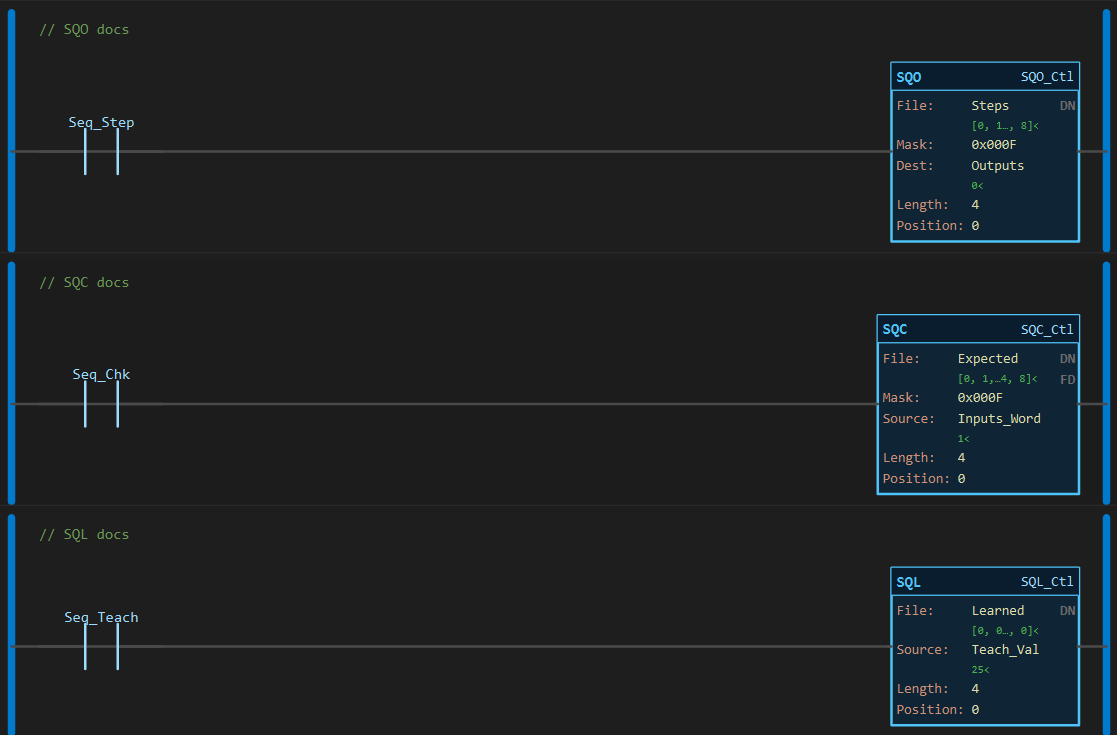
—] [Seq_Step———[SQO SQO_Ctl Steps 0x000F Outputs 4]———Scan 1 — Seq_Step = 0. Position 0, nothing has been output: Outputs reads 0 and DN is dark. The SQC and SQL rungs below are the examples from their own pages, parked. A File operand lists the array’s values, trimmed in the middle when it is long.
Scan 2 — Seq_Step = 1. Position advances to 1 and Steps[1] is written: Outputs reads 1, station 1 on.
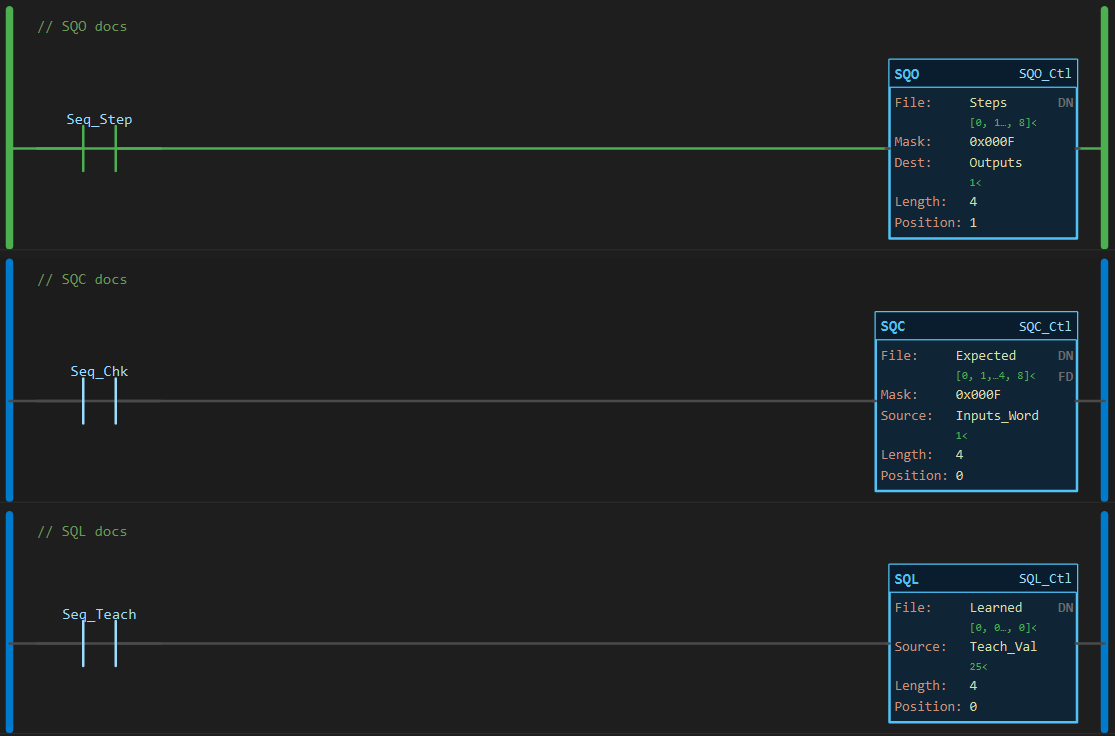
Three more edges write 2, 4 and 8; on the fourth DN lights. The next edge wraps to position 1 and writes 1 again.
Control Tag Errors and Troubleshooting
Section titled “Control Tag Errors and Troubleshooting”Error definitions
| .ER cause | Condition that sets it | .POS / status value |
Meaning |
|---|---|---|---|
| None | .ER is never set by LadderIDE |
— | A File that is not an INT/DINT array, or a Length of array size or more, is refused when the project is validated. |
Troubleshooting hints
Symptom: The first edge outputs step 1, not step 0. Likely cause: Position 0 is the parked start; the first advance goes to 1. Fix: Put the first real pattern in element 1. Element 0 is never output.
Symptom: Bits outside the sequence change unexpectedly. Likely cause: The mask covers bits other rungs also write, or the mask is wider than intended. Fix: Narrow the mask to exactly the bits the sequencer owns; other rungs may then drive the rest of Dest.
Symptom: The sequencer restarts at step 1 after a power cycle. Likely cause: POS is not retained; it is loaded from Position at power-up. Fix: That is the intended behaviour. A cycle that must resume needs its own step memory.
See Also
Section titled “See Also”- SQC — Sequencer Compare (check inputs against a table)
- SQL — Sequencer Load (teach the table from live values)
- RES — Reset (park at position 0)
- AND — Bitwise AND (the same masking on its own)
- Shift/Sequencer Instructions — Category index
Timed steps. Drive the rung from a TON’s DN with the timer reset on each step; the sequencer advances once per timeout.
Dwell on a step. The outputs hold while the rung stays false, so a step that waits on a sensor is a rung condition, not a special step.
The block colours neutral. Watch the rung wire, the Position row and DN.
Applies to LadderIDE >=1.2.2 · Last reviewed 2026-09-11 · Screenshots verified 2026-09-11