
BSR — Bit Shift Right
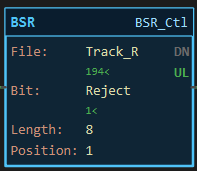
Description
Section titled “Description”BSR (Bit Shift Right) shifts every bit of a register one place toward bit 0 each time its rung goes from false to true. The Bit Address enters at the top, position Length − 1, and bit 0 falls out into the control tag’s UL member. It is BSL run the other way, for a line whose stations are numbered from the far end, or a register that must be read from bit 0 as the “oldest” position. Do not put an ONS ahead of it; the instruction detects its own rising edge.
Operands
Section titled “Operands”| Operand | Type | Format | Valid Range | Required | Description |
|---|---|---|---|---|---|
| Control | CONTROL tag | Tag or Tag[n] |
One BSR per control tag | Yes | Holds LEN, POS and the status bits. |
| File | INT or DINT tag, scalar or array | Tag (never an element) |
Any | Yes | The shift register; capacity 16 bits per INT, 32 per DINT, times the array size. |
| Bit | BOOL tag, INT/DINT bit or literal | Tag, Word.n, 0, 1 |
Any resolvable bit | Yes | The value shifted in at bit Length − 1. |
| Length | Whole number | 8, 16, 84 |
1 to the register’s capacity in bits | Yes | How many bits take part. Bits above Length are cleared on every shift. |
Everything said about capacity and addressing on the BSL page applies here.
Scan Behavior
Section titled “Scan Behavior”Prescan
Section titled “Prescan”LEN is loaded from the instruction’s Length and POS starts at 0. The status bits and UL are clear.
Rung-condition-in is false
Section titled “Rung-condition-in is false”EN is cleared. Nothing shifts; the register and every status bit hold.
Rung-condition-in is true
Section titled “Rung-condition-in is true”On the scan the rung turns true, one shift happens: UL takes bit 0, every bit moves down one place, and the Bit operand enters at position Length − 1. POS counts the shift up to Length; DN sets once POS reaches Length. No further shift happens until the rung has been false again.
Postscan
Section titled “Postscan”Nothing.
| Condition | EN | DN | UL | POS | Register |
|---|---|---|---|---|---|
| Power-up | 0 | 0 | 0 | 0 | as loaded |
| Rung false | 0 | holds | holds | holds | holds |
| False → true | 1 | POS ≥ LEN | bit 0 before the shift | +1, to LEN | shifted |
| Held true | 1 | holds | holds | holds | holds |
| RES on the control | 0 | 0 | 0 | 0 | holds |
Member Bits
Section titled “Member Bits”| Bit | Mnemonic | Data type | Set by | Cleared by | Operation description |
|---|---|---|---|---|---|
| Enable | .EN |
BOOL | The rung being true | The rung being false, or RES | Mirrors the rung condition. |
| Enable unload | .EU |
BOOL | Never | RES | Reserved; BSR does not use it. |
| Done | .DN |
BOOL | POS reaching LEN | RES | The register has been shifted LEN times since the last reset. |
| Empty | .EM |
BOOL | Never | RES | Not used by BSR. |
| Error | .ER |
BOOL | Never | RES | Reserved. Bad operands are refused at validation. |
| Unload | .UL |
BOOL | The bit that left bit 0 on the last shift | The next shift, or RES | Holds the bit that fell out of the bottom of the register. |
| Inhibit | .IN |
BOOL | Never | RES | Reserved. |
| Found | .FD |
BOOL | Never | RES | Not used by BSR. |
| Length | .LEN |
INT | The instruction’s Length at power-up | Never (RES preserves it) | Bits in the register; clamped to the file’s capacity at runtime. |
| Position | .POS |
INT | Each shift, up to LEN | RES | Counts shifts since the last reset. |
Example
Section titled “Example”Scenario: The same reject-tracking register as the BSL example, on a line that indexes the other way. The reject flag enters at position 7 and rides down to bit 0, where the blow-off reads UL.
Tags:
Index_R— Conveyor index pulse, BOOLReject— Infeed reject flag, BOOLTrack_R— Reject register, INTBSR_Ctl— Control, CONTROL, Length 8
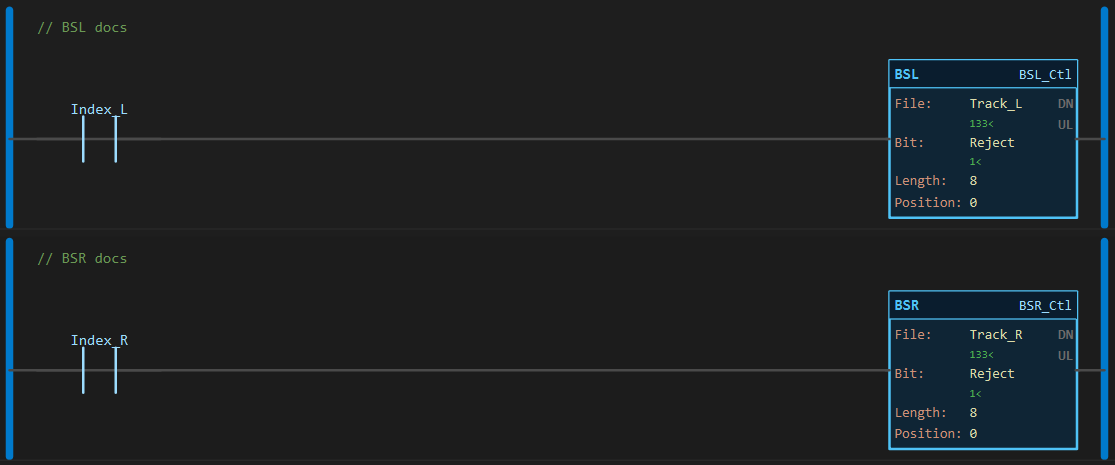
Rung 1:
—] [Index_R———[BSR BSR_Ctl Track_R Reject 8]———Scan 1 — Index_R = 0. Track_R reads 133 (bits 7, 2 and 0 set) and Reject reads 1. The rung is false: Position 0, DN and UL dark. The BSL rung above it is the BSL page’s example, parked at the same values.
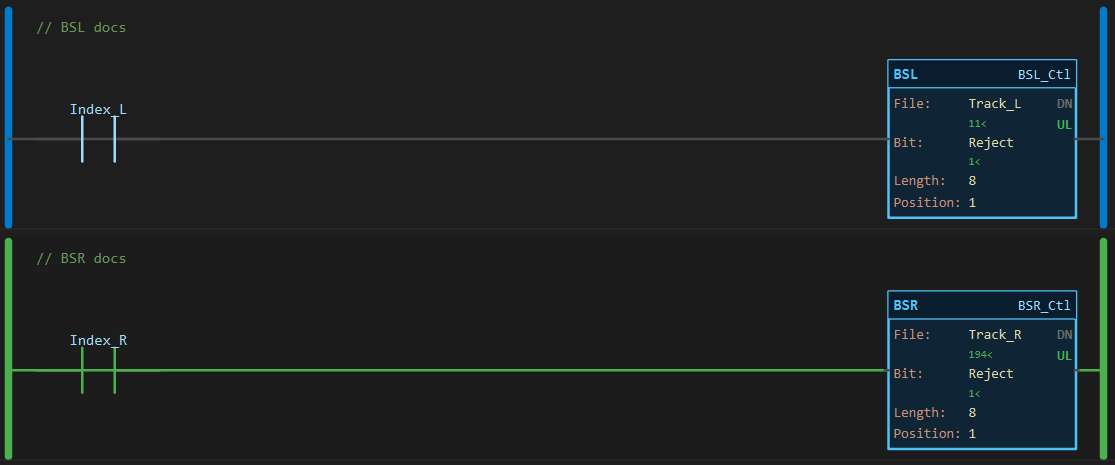
Scan 2 — Index_R = 1. One shift: bit 0 leaves into UL, everything moves down, the reject flag enters at bit 7. Track_R reads 194, UL is lit, Position 1. The BSL rung above has already taken its own shift and shows 11.
Binary Result
Section titled “Binary Result”BSR — File Track_R (INT), Length 8, Bit = 1
15 14 13 12 11 10 9 8 7 6 5 4 3 2 1 0Before 0 0 0 0 0 0 0 0 1 0 0 0 0 1 0 1 = 133After 0 0 0 0 0 0 0 0 1 1 0 0 0 0 1 0 = 194 ^ ^ Bit operand shifted in bit 0 shifted outUL (bit 0 shifted out) = 1Bits 8..15 are outside Length and are cleared.Control Tag Errors and Troubleshooting
Section titled “Control Tag Errors and Troubleshooting”Error definitions
| .ER cause | Condition that sets it | .POS / status value |
Meaning |
|---|---|---|---|
| None | .ER is never set by LadderIDE |
— | A File that is not an INT/DINT tag, an element reference, or a Length outside 1..capacity is refused when the project is validated. |
Troubleshooting hints
Symptom: The register shifts the wrong way. Likely cause: BSL and BSR look alike on the rung. Fix: Read the block title; the Bit operand enters at bit 0 for BSL and at bit Length − 1 for BSR.
Symptom:
.ULis never set although bits reach the bottom. Likely cause: UL holds the bit that leaves on the most recent shift only; it is overwritten by the next shift. Fix: Read.ULon the scan after the shift, or latch it with OTL.
Symptom:
.DNis set and stays set. Likely cause:.POShas reached.LEN. Fix: RES the control tag at the start of a batch.
See Also
Section titled “See Also”- BSL — Bit Shift Left (capacity, addressing and the long-register notes)
- RES — Reset
- Shift/Sequencer Instructions — Category index
Which end is “in”. BSL fills from bit 0 upward, BSR from the top downward. Pick the one whose bit numbering matches the station numbering on the machine so Track.n reads as station n.
The block colours neutral. Watch the rung wire, the Position row and the DN/UL indicators.
Applies to LadderIDE >=1.2.2 · Last reviewed 2026-09-11 · Screenshots verified 2026-09-11