
ABS — Absolute Value
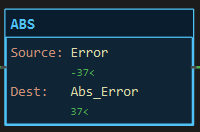
Description
Section titled “Description”ABS (Absolute Value) writes the magnitude of Source to Dest every scan its rung is true: a negative value loses its sign, a positive value is copied unchanged. It is an output instruction with no state and no status bits. Use ABS when only the size of a difference matters, such as a deviation alarm that should fire whether the reading is high or low. Do not use ABS to clamp a value at zero; that keeps −5 as 5, not 0. Use a LES test and a MOV for a floor.
Operands
Section titled “Operands”| Operand | Type | Format | Valid Range | Required | Description |
|---|---|---|---|---|---|
| Source | Any numeric tag, member, element or bit, or a literal | Tag, Tag.Member, Tag[n], Tag.bit, or a literal |
Any resolvable numeric reference | Yes | The value whose magnitude is wanted. |
| Dest | A writable numeric tag, member or element | Tag, Tag.Member, Tag[n] |
SINT, INT, DINT or REAL; not a literal, not an input pin | Yes | Where the magnitude is written. |
Dest may be the same tag as Source. A REAL Source keeps its fraction when Dest is REAL and loses it when Dest is a whole-number type.
Range edge. The most negative value of a whole-number type has no positive twin: ABS of −32768 in an INT stays −32768. A REAL has no such edge.
Scan Behavior
Section titled “Scan Behavior”Prescan
Section titled “Prescan”Nothing. Dest keeps its power-up value.
Rung-condition-in is false
Section titled “Rung-condition-in is false”The instruction does nothing. Dest holds its last value.
Rung-condition-in is true
Section titled “Rung-condition-in is true”Source is read and its magnitude is written to Dest every scan the rung is true.
Postscan
Section titled “Postscan”Nothing.
Example
Section titled “Example”Scenario: A temperature loop computes the difference between setpoint and measurement. A deviation alarm should fire when that difference is large in either direction, so the sign is removed before the compare.
Tags:
Eval— Evaluate deviation, BOOLError— Setpoint minus measurement, INTAbs_Error— Size of the error, INT
Rung 1:
—] [Eval———[ABS Error Abs_Error]———Scan 1 — Eval = 0. Error reads −37, the measurement is above setpoint. The rung is false: Abs_Error holds 0.

Scan 2 — Eval = 1. Abs_Error reads 37. A GRT Abs_Error 25 on the next rung fires the alarm for a reading 37 degrees high or 37 degrees low alike.

See Also
Section titled “See Also”- NEG — Negate
- SUB — Subtract (the usual source of a signed error)
- LIM — Limit Test (a deadband without ABS)
- CPT — Compute (
ABS(Setpoint − Actual)in one instruction) - Compute Instructions — Category index
Deadband in one line. LIM −25 Error 25 is true inside the band without computing the magnitude at all. ABS earns its place when the magnitude is used more than once.
The block never colours. Watch the rung wire and the Dest value line.
Applies to LadderIDE >=1.2.2 · Last reviewed 2026-09-11 · Screenshots verified 2026-09-11